Rated 4.9Lowest price on the ice
3 h3-Hour Tasman Glacier Helicopter Ride and Hike
★ 4.9 · 328 reviews
- Three hours, Land high on the Tasman Glacier
- Crampons and guiding included
- Day trip
- Free cancellation
$514$171.33 / hour
Check availability→ Before you set off
There are two quite different days out here and they need different things in the bag. The walk from the valley car park to the lookout is a short climb in whatever the weather is doing, and you dress for a mountain valley. The heli hike is three hours with two of them on the ice, and the technical gear comes with the booking: crampons and guiding are included from $514. This page sets out what you bring, what is supplied, and where people get it wrong.
Quick answer
The short answer. For the free view track: closed shoes with grip, a warm layer, a windproof jacket, sun protection and water. For a heli hike from $514: the same base layers, plus the boots and crampons the operator supplies — do not buy crampons for this. Whatever you are doing, take one more warm layer than the valley temperature suggests, because a national park in the Southern Alps changes quickly and the ice is colder than the car park.
The valley walk and the ice are different days
The track needs ordinary outdoor clothing. The ice needs gear, and the gear is included.
The Tasman Glacier View Track is a short walk from the valley car park onto the moraine ridge, finishing at a lookout above the lake. It is an outdoor walk in a mountain environment, not a technical undertaking. Closed shoes with some grip, a warm layer, something windproof and water are enough, and the whole thing works in weather that grounds aircraft.
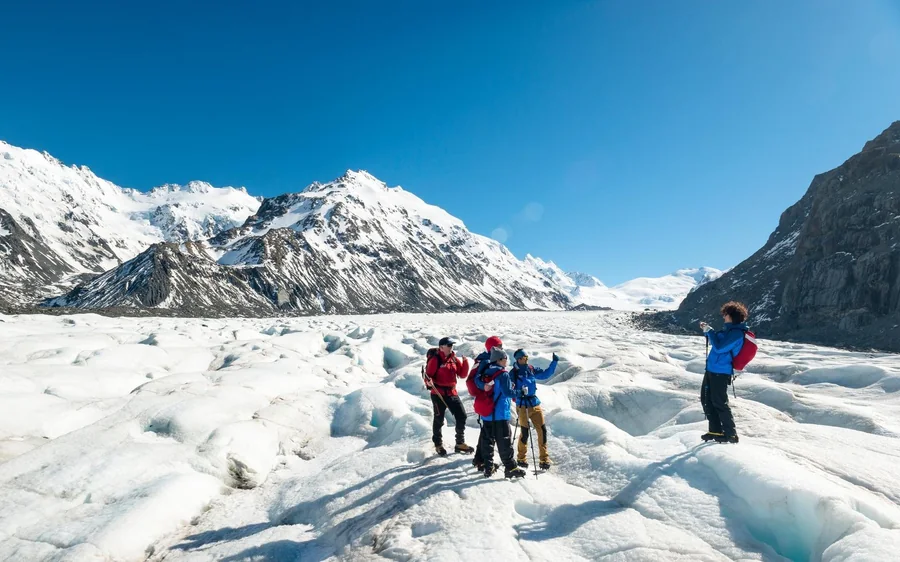
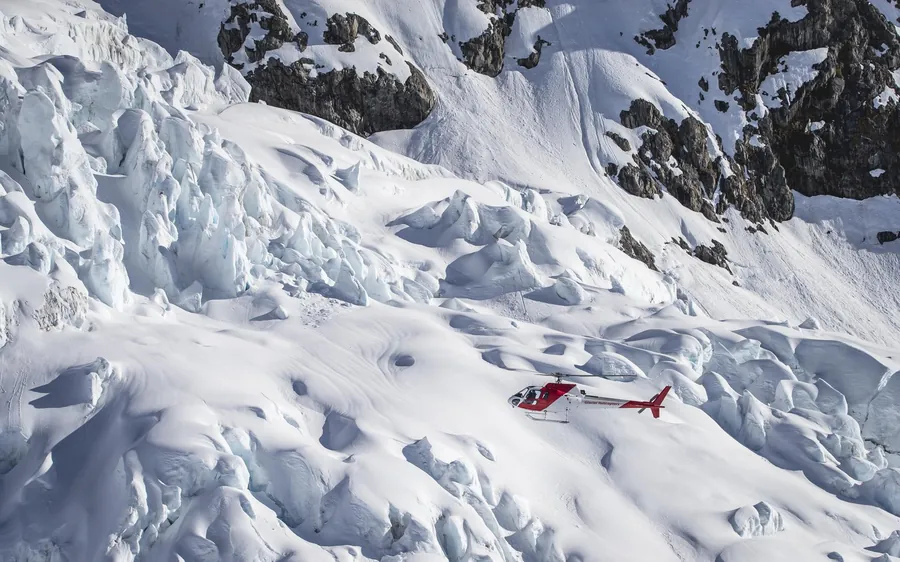
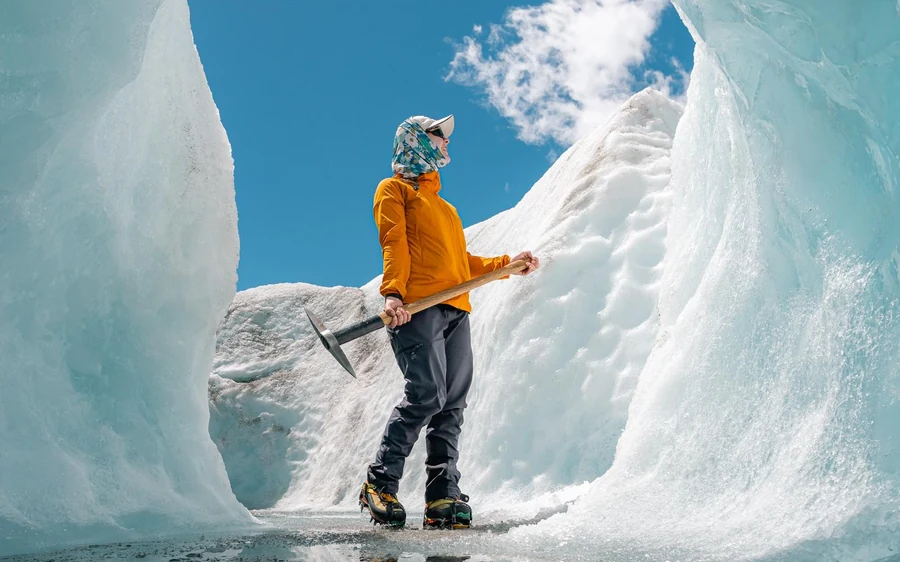
A heli hike is a different proposition. You fly, you land on the glacier, and you spend two hours walking on ice with a guide. That needs proper boots and crampons, and both come with the booking — the listing for the three-hour trip at $514 states crampons and guiding included, and the guides fit everything before you leave the ground. Buying your own for a one-off trip is money you do not need to spend.
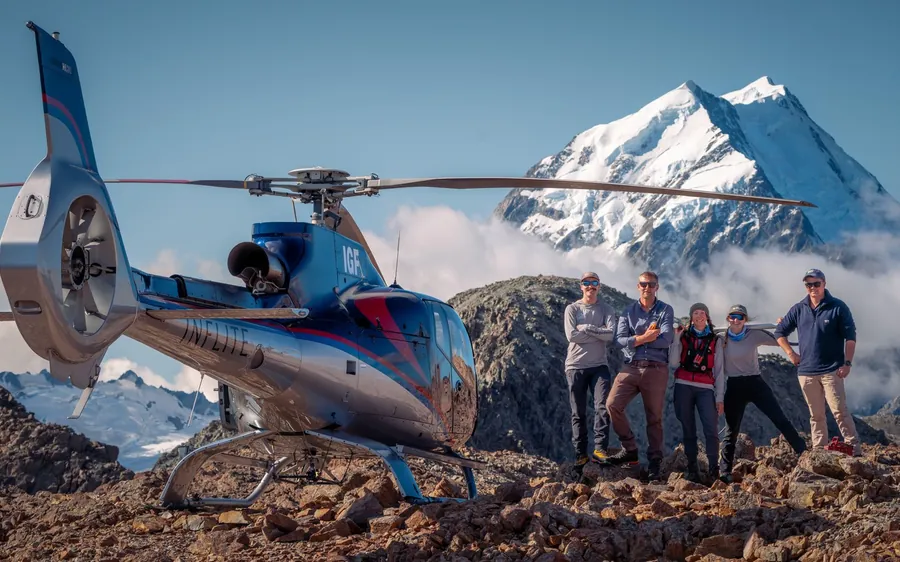
The scenic flights sit outside both categories. On a flight with an alpine landing from $217 you step out onto snow for a short time near the aircraft, so warm clothing and sunglasses matter, but none of the walking gear does. The flights that stay in the air — $363 over the park, $477 across the divide — need nothing beyond what you would wear to the airfield.
One question comes up constantly: can you just walk out onto the glacier in the gear you have? The honest answer is that the route does not exist. The lake and the moraine sit between the track and the ice, and the ice is reached by helicopter. The gear question only starts once you have a booking that lands there.
What to bring
This works for the view track and doubles as the base layer under everything the operator gives you on a heli hike.
Fleece or similar. The valley can be pleasant and the ice cold on the same morning, and the thing people most often wish they had packed is one more warm layer. Take it even if the forecast looks kind.
Wind is the variable that turns a mild day sharp in a mountain valley, and it is also the thing most likely to change while you are out. A shell over your warm layer covers both wind and passing rain.
For the view track, the surface is a formed path onto loose moraine, and smooth soles are the wrong tool. For a heli hike this matters less, because you are fitted with proper boots before you fly.
Snow and ice reflect light back at you from below, which is why people who never burn manage it on a glacier. Take both in every season, including winter, and apply the sunscreen before you get on the aircraft.
Small, light, and the difference between enjoying two hours on the ice and counting the minutes. Thin liner gloves are easier for a camera than thick ones.
The trips on this site run from twenty-five minutes to a full day. Anything at the longer end — the heli hikes at three hours, the Queenstown round trip at $1,029 at six — is long enough that food and water matter.
Cold flattens batteries faster than people expect. Keep the spare in an inside pocket where your body heat reaches it, and you will not lose the last half hour on the ice.
What the operator supplies
Boots, crampons and the technique are theirs. Layers, hands, head and eyes are yours.
On the guided heli hikes the technical equipment is part of the booking. The listing for the three-hour trip at $514 is explicit that crampons and guiding are included, and the practical shape of the morning follows from that: you arrive, you are fitted with boots and crampons, you get a briefing, and you fly. Nobody expects you to turn up with mountaineering gear, and nobody expects you to know how to walk in crampons.
That last point is worth stating plainly, because it is the thing that stops people booking. Walking on ice in crampons is a skill you are taught on the spot, in the first few minutes, by a guide who does it every day. The technique is short-stepped and flat-footed and it becomes automatic quickly. The trips carry 328 and 260 reviews at 4.9 and 4.8, and those numbers include a great many people who had never worn crampons before.
What is not supplied is your own clothing. Base layers, warm mid layer, hat, gloves, sunglasses and sunscreen are yours to bring, and the operator will tell you the same thing when you book. The jacket question varies by operator and by day, so read the listing and the confirmation rather than assuming either way.
Want the ice trip itself explained — the flight, the landing and the two hours?
The Tasman Glacier heli hike→Children, fitness and how hard it actually is
The lookout suits almost everyone. The ice needs ordinary fitness, not experience.
The view track is the accessible end of this. It is a short climb to a lookout, and the people doing it on any given morning range from small children to visitors well into their seventies. If you can manage a staircase and uneven ground, you can manage the lookout.
A heli hike asks more, but less than people assume. You are walking on ice for around two hours at a pace the guide sets, with stops. It is not a climb and it is not a long distance day; it is a couple of hours of careful walking in equipment that does the gripping for you. Reasonable general fitness and a willingness to be told where to put your feet is the requirement.
Age limits, weight limits and any medical conditions that affect flying are set by each operator and published on the listing. Those are exactly the details to read before you book rather than on the morning, and they differ between the three-hour trips at $514 and $540 and the six-hour Queenstown version at $1,029.
For families where one person wants the ice and another does not, the combination that works is a flight with an alpine landing at $217 — twenty-five minutes, 517 reviews, a landing on snow without the hiking — alongside the free walk to the lookout for anyone who would rather keep both feet in the valley.
Book direct
The two guided hikes that supply crampons, the two landings that do not need them, and the long day from Queenstown.
★ 4.9 · 328 reviews
★ 4.8 · 260 reviews
★ 4.7 · 517 reviews
★ 4.8 · 46 reviews
★ 4.5 · 11 reviews
Common questions
Not your own. On the guided heli hikes the crampons and the guiding are included in the booking — the three-hour trip at $514 states this on the listing, and boots are fitted before you fly.
Closed shoes with grip, a warm mid layer, a windproof jacket, sunglasses, sunscreen and water. It is a short climb onto the moraine to a lookout, not a technical walk, but it is still a mountain valley.
The operator supplies boots suitable for crampons and fits them before the flight. Bring comfortable socks and wear something ordinary to the base.
Yes, in every season. Snow and ice reflect light upwards as well as down, which catches out people who rarely burn. Sunglasses matter for the same reason.
Age and weight limits are set by each operator and published on the listing, so check the trip you are booking. The free view track has no such limits and suits most ages.
For the lookout, enough for a short climb on uneven ground. For a heli hike, around two hours of steady walking on ice at a guided pace, with stops — ordinary fitness rather than experience.
That is the normal case. Guides teach the technique in the first few minutes on the ice, and the trips carry 328 and 260 reviews at 4.9 and 4.8 from people who mostly had not worn them before either.
Go deeper
The free view track, the flights with a landing, and the two hikes that walk on the ice.
The free view trackThe short walk from the valley car park, and exactly what it shows you.
Can you walk on itThe honest answer, and what the helicopter is actually for.
The heli hikeTwo hours on the ice, what is supplied, and how the two versions differ.
How long it takesTimes for the view track, the flights and the hikes, in one place.
Which glacier to walkTwo very different days out, compared on what you actually get.
3 Hour Heli Hike to the Tasman Glacier
★ 4.8 · 260 reviews · Free cancellation 24 h