Dec – Feb
Summer
Long daylight, the warmest conditions on the ice and the fullest booking sheets. Book a few weeks ahead, because the village is small and the machines are not.
The walk on the ice
The Tasman Glacier is the longest glacier in New Zealand, and every trip that walks on it starts with a helicopter. Three do exactly that: two from Mount Cook Village at $514 and $540, and a full day from Queenstown at $1,029. Between them they hold 599 reviews. This page is what a heli hike actually is, how the day runs, what the price covers, and why the mountain weather has more say in your booking than you do.
Quick answer
The short answer. A Tasman Glacier heli hike is a helicopter transfer onto the ice, crampons, and guided walking on the glacier surface. From Mount Cook Village there are two, both three hours door to door: the helicopter ride and hike at $514, rated 4.9 across 328 reviews, and the heli hike at $540, rated 4.8 across 260 reviews, which lists two hours walking on the glacier. From Queenstown a six-hour day does the same thing at $1,029, flying you over the Southern Alps by plane before the helicopter transfer. Nothing else here puts you on the ice: every other trip either lands on snow beside the machine or stays in the air.
What it is
Fly up the valley, land on clean ice, put crampons on, walk with a guide, fly back.
The Tasman Glacier fills a long valley on the eastern side of the main divide, below Aoraki / Mount Cook. The lower end of it — the part you can see from the valley floor — is grey with rock debris and ends in a lake. That is not where anybody walks. The walking happens higher up, where the surface is clean white ice, and the only practical way to get there is to fly.
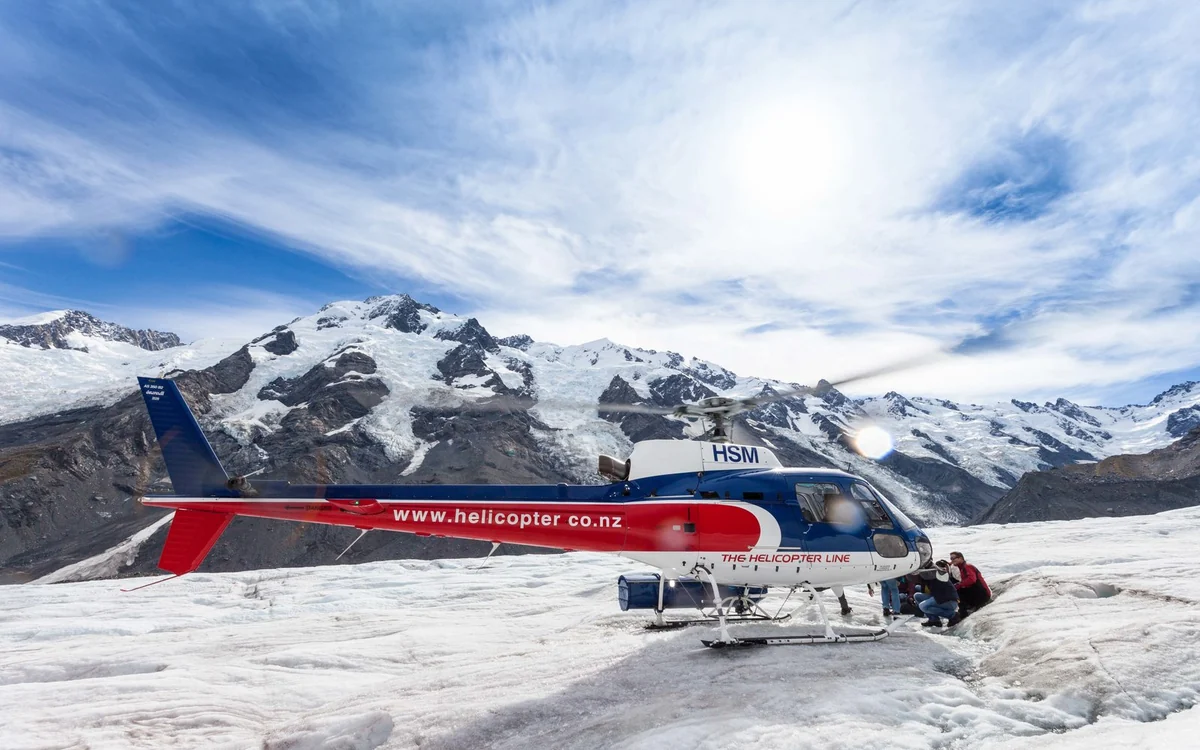
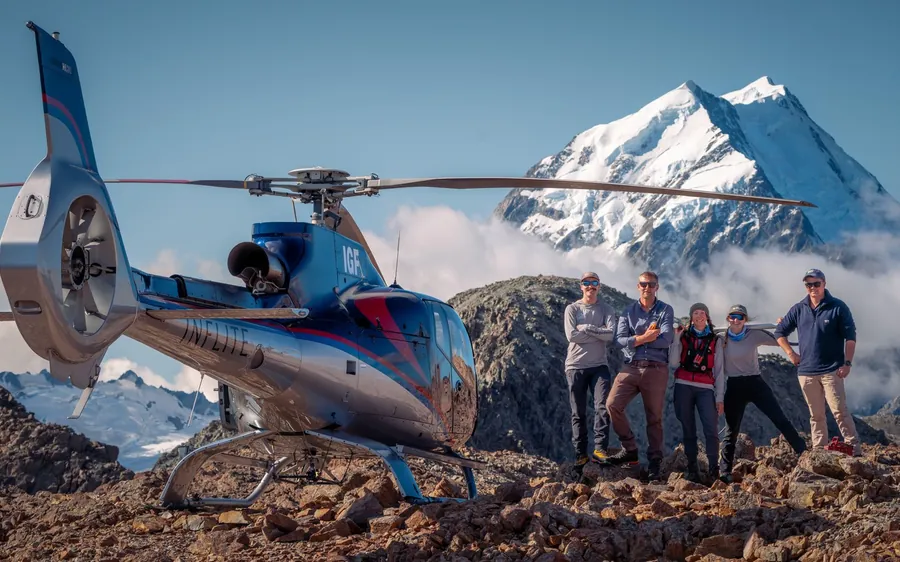
So a heli hike has two halves. The first is a helicopter flight from Mount Cook Village up the Tasman Valley, which by itself is what most people would call a scenic flight: the valley opens out underneath you, Aoraki stands on your right, and the glacier runs away in front. The second half is the part you booked for. The machine sets down on the ice, the rotors wind down, and you step out onto a glacier with a guide.
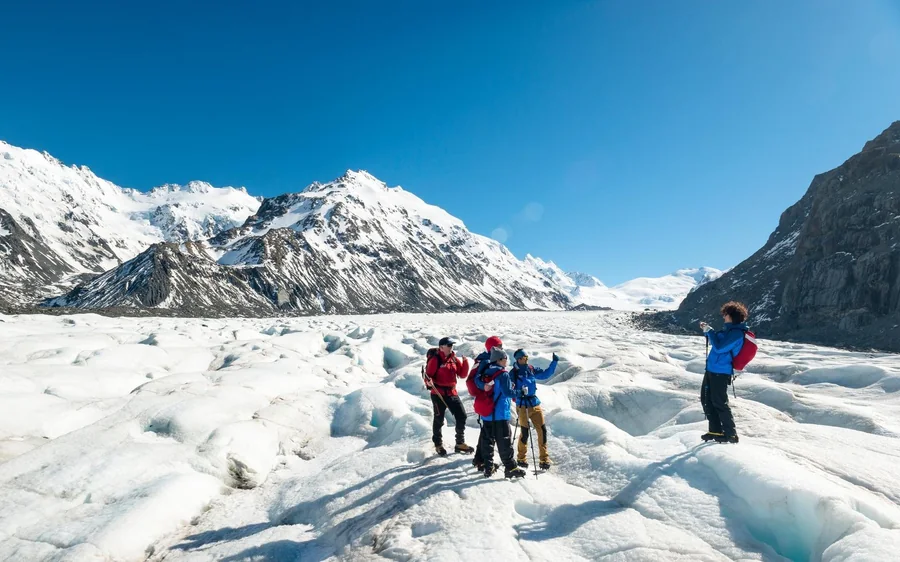
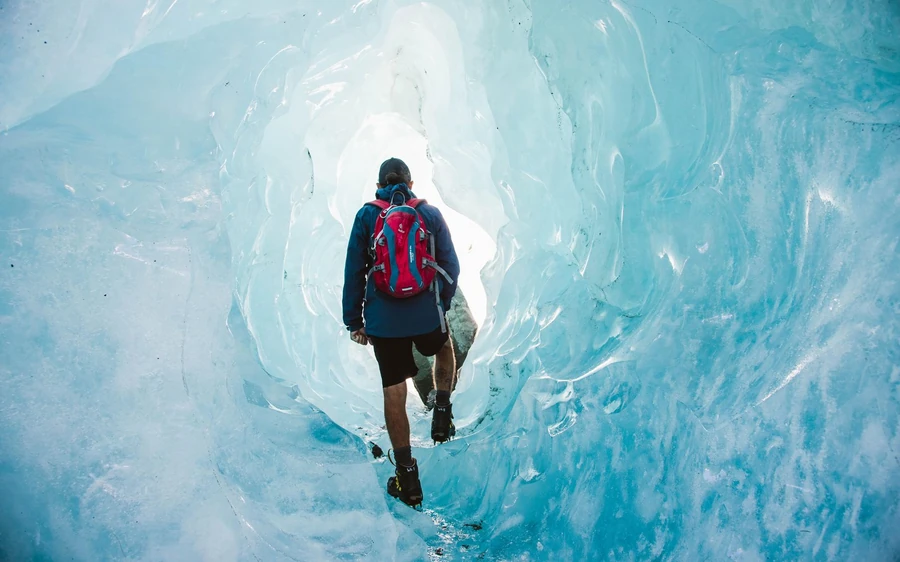
From there it is walking. Crampons go on over your boots, the guide picks the line, and the group moves across a surface that changes every week: meltwater channels, small ridges, blue walls where the ice has cracked open. The listing for the $514 trip describes exactly this — the helicopter fly-by of the country’s largest mountain, then walking on New Zealand’s biggest glacier. The other village trip, at $540, is listed as two hours walking on the glacier within a three-hour trip.
Then the helicopter comes back for you. That is the shape of every heli hike sold here, and the differences between the three are differences of length, price and where the day starts — not of what you do once you are standing on the ice.
The day in order
The two village trips are both listed at three hours. This is where those hours go.
Both Mount Cook Village trips start at the operator’s base rather than at a trailhead, so there is no drive and no parking problem at the start of the day. This is also the point at which the day is confirmed or moved, because the flying decision is made on the morning conditions rather than the forecast you read the night before.
Boots and crampons are fitted before you fly — the $514 listing states plainly that crampons and guiding are included. The briefing covers how to walk in crampons, which is less obvious than it sounds and takes about one lap of the room to learn.
The helicopter climbs the Tasman Valley with Aoraki / Mount Cook alongside. This is the section people photograph most and it is included in the trip length, not extra to it.
The machine sets down on the glacier in the upper basin, where the surface is white rather than the rock-covered grey you see from the valley. The engine noise stops, and what is left is a very particular kind of quiet that everybody comments on.
This is the heart of it. The $540 trip lists two hours walking on the glacier; the guide chooses the route on the day, because the surface here reshapes itself constantly and last week’s line may not exist. Expect to stop often — for the ice formations, for the mountain views, and because a guide who works this glacier will have something to say about all of it.
Three hours door to door means a heli hike is a half day, not a whole one. People routinely fly in the morning and still drive on to Lake Tekapo or Queenstown the same afternoon.
The three trips
Two half-days from the village, one full day from Queenstown — same ice, different day.
There are three, and they are genuinely different purchases.
The $514 trip — 3-Hour Tasman Glacier Helicopter Ride and Hike. This carries 328 reviews at 4.9, the most reviews and the highest rating of anything on this site. Its listing is the one that spells out crampons and guiding included, free cancellation, and a small group; it also carries the operator’s own “likely to sell out” flag, which is their label and not ours. If you want the safest booking of the three, this is it.
The $540 trip — 3 Hour Heli Hike to the Tasman Glacier. Rated 4.8 across 260 reviews, and the one that states the number people actually want: two hours walking on the glacier out of a three-hour trip. That is a lot of time on the ice for a half day, and it is the reason this is our top pick.
The $1,029 day from Queenstown. Six hours, rated 4.5 across 11 reviews. The listing describes flying by plane over the Southern Alps, transferring onto the ice by helicopter, then crampons and an expert guide — two hours on the Tasman ice. It costs roughly twice the village trips because it is not the same product: it is a whole day out of Queenstown with the alpine crossing built into it, for people who are not going to drive four hours each way to Mount Cook Village and back.
Put simply: if you are staying at Aoraki, book one of the village trips. If you are based in Queenstown and the glacier is the thing you came to New Zealand for, the day trip is the only version of it that fits.
Working out how much of your day each trip takes?
How long it takes→Before you book
Practical, and all of them affect whether your booking actually flies.
Helicopters need visibility and acceptable wind at the landing site, and mountain conditions change through the morning. Operators make the call on the day. This is normal here and it is the single most important thing to plan around.
The most reliable way to fly is to be in the area for two nights rather than one. If the first morning is out, the second usually is not, and you have a spare slot rather than a cancelled plan.
The $514 trip lists free cancellation. If your itinerary is still moving, that is worth more than the difference in price between the two village trips.
Mountain weather generally builds through the day. Morning slots have the better record, and an early flight leaves the rest of the day free for the valley and the lakes.
The village can be warm while the landing site is not. Layers, a windproof jacket, gloves and sunglasses are the sensible minimum — the reflected light off snow is strong.
Crampons are supplied, and they attach to proper boots. If you are travelling light, check with the operator before you arrive rather than on the morning.
Through the year
Trips run all year. What changes is the length of the day, the temperature on the ice and how often a morning gets weathered out.
Dec – Feb
Long daylight, the warmest conditions on the ice and the fullest booking sheets. Book a few weeks ahead, because the village is small and the machines are not.
Mar – May
Settled spells between fronts, cooler air, fewer people in the village. A good compromise between weather odds and crowds.
Jun – Aug
Cold and clear between systems, with snow low on the valley walls and the shortest days. Layers matter more, and so does having a spare morning.
Sep – Nov
Changeable, bright, and busy with meltwater lower down. Conditions can swing quickly, which again argues for two nights in the area rather than one.
Book direct
The two village trips that walk on the Tasman ice, the Queenstown day that does the same, and the short scenic flight with an alpine landing if the ice is not what you are after.
★ 4.9 · 328 reviews
★ 4.8 · 260 reviews
★ 4.5 · 11 reviews
★ 4.7 · 517 reviews
Common questions
Yes — on a guided heli hike. The helicopter lands you on the clean ice in the upper basin, you walk in crampons with a guide, and you fly back. There is no walking route from the valley floor onto the glacier, so the flight is the access, not a luxury.
From Mount Cook Village, $514 or $540, both three hours door to door. From Queenstown, $1,029 for a six-hour day that includes the alpine flight each way.
The $540 trip lists two hours walking on the glacier within a three-hour trip, and the Queenstown day lists two hours on the Tasman ice as well. The rest of the time is kit, briefing and flying.
No. These are guided walks on a prepared route with crampons supplied and a briefing before you fly. What they ask for is ordinary mobility and a willingness to walk for a couple of hours on uneven ground.
Operators make the call on the morning and move or refund the booking. The $514 trip carries free cancellation on its listing, and the practical answer for everybody is to keep a spare morning in the area rather than to book the last one.
They answer different questions. A scenic flight with an alpine landing, from $217, shows you the glacier and puts you on snow beside the machine for a few minutes. Only the heli hike gives you time walking on the glacier itself with a guide, and that is what people describe afterwards.
Yes, and the $1,029 trip is exactly that: six hours, plane over the Southern Alps, helicopter transfer onto the ice, two hours walking with a guide, then the flights back. It is the only listing here that reaches the Tasman ice without staying at Mount Cook.
3 Hour Heli Hike to the Tasman Glacier
★ 4.8 · 260 reviews · Free cancellation 24 h